
So you want to start a blog. That’s great! Not only is blogging a great pastime, but with a blog you can express yourself in a unique way, help others with problems you’ve overcome, establish yourself as an expert, and even make money.
If you’re new to blogging, it really helps to get started off on the right foot and have someone to help you avoid mistakes.
That’s why I’ve put this page together for you, to give beginners a fast, foolproof guide to starting a blog, without having to learn HTML or waste your time reading long, boring tutorials. In fact, over 9,500 people have already setup blogs using this guide!
I’ve put this guide together for you, to walk you through the process to setup your blog in 5 easy steps.
Here’s how to start a blog:
- Choose a blogging platform.
- Register a domain name and hosting.
- Design your blog.
- Add posts and pages.
- Start growing your blog.
The goal of this page is to help you get started the right way. From years of coaching and helping people with their blogs, I’ve found that many people make mistakes when starting a blog, sometimes resulting in them abandoning the project altogether. We don’t want that to happen.
So I want you to take the time to thoroughly read this post. It’s about 4000 words long (20 minutes), so get comfy and set aside some time; I’m going to walk you through the entire process of setting up your self-hosted blog, so you ‘get it right the first time’.
Step 1: Choose the right blogging platform (WordPress)
What do you need to start a WordPress blog?
There are three things you need to start a WordPress blog:
- A domain name idea (this will be the name of your blog i.e wpbeginner.com)
- A web hosting account (this is where your website live on the internet)
- Your undivided attention for 30 minutes.
Yes, you read it right. You can start a blog from scratch in less than 30 minutes, and we will walk you through the whole process, step by step.
In this tutorial, we will cover:
- How to Register a Domain Name for Free
- How to Choose the Best Web Hosting
- How to Install WordPress
- How to Change Your Theme
- How to Write Your First Blog Post
- How to Customize WordPress with Plugins
- How to Make Money From Your Blog
- Resources to Learn and MasterWordPress
Ready? Let’s get started.
Step 1. Setup
The biggest mistake beginners make when starting a blog is choosing the wrong blogging platform. Thankfully you’re here, so you won’t be making that mistake.
For 95% of users, it makes more sense to use WordPress.org also known as self-hosted WordPress. Why? Because it is free to use, you can install plugins, customize your site design, and most importantly make money from your site without any restrictions (see the difference between WordPress.com vs WordPress.org).
Now you have probably heard that WordPress is free.
You might be wondering why is it free? What’s the catch?
There’s no catch. It’s free because you have to do the setup and host it yourself.
In other words, you need a domain name and web hosting.
A domain name is what people type to get to your website. It’s your website’s address on the internet. Think google.com or wpbeginner.com
Web hosting is where your website live. It’s your website’s house on the internet. Every website needs web hosting.
A domain name typically costs $14.99 / year, and web hosting normally costs $7.99 / month.
That’s a lot for beginners who are just starting out.
Thankfully, Bluehost, an official WordPress recommended hosting provider, has agreed to offer our users a free domain name and over 60% off on web hosting.
Bluehost is one of the oldest web hosting companies, started in 1996 (that’s before Google). They are also the largest brand name when it comes to WordPress hosting because they host millions of websites including our own.
On top of all this, Bluehost has been working with WordPress since 2005, and they are committed to giving back. That’s why they have promised us that if you cannot get your blog online within 30 minutes by following this tutorial, then our expert team will complete the process for you without any cost. They will compensate us, so you don’t have to. Contact us for free blog setup help.
NOTE: At Complete9inja we believe in transparency. If you sign up with Bluehost using our referral link, we will earn a small commission at no extra cost to you (in fact, you will save money and get a free domain). We would get this commission for recommending just about any WordPress hosting company, but we only recommend products that we use personally use and believe will add value to our readers.
Let’s go ahead and purchase your domain + hosting.
Open up Bluehost in a new window and follow along.
First thing you need to do is click on the green Get Started Now button to get started.

On the next screen, select the plan that you need (basic and plus are the most popular).
After that, you will be asked to enter the domain name for your website.

Lastly, you will need to add your account information and finalize the package info to complete the process. We recommend going with the 36 month plan because that’s best value.
On this screen, you will see optional extras that you can purchase. It’s entirely up to you whether or not you purchase these, but we generally don’t recommend purchasing them right away. You can always add them later on, if you decide that you need them.

Once completed, you will receive an email with details on how to login to your web hosting control panel (cPanel). This is where you manage everything from support, emails, among other things. But most importantly, this is where you install WordPress.
Step 2. Install WordPress
In the cPanel, you will see dozens of small icons for different services and features. This can be a bit overwhelming, so ignore 95% of them because you will never need to use them.
Scroll down to the website section and click on the WordPress icon.

You will be redirected to the Bluehost Marketplace Quick Install screen for WordPress. Click on the Get Started button.
On the next screen, you will be asked to select your domain name. Choose the domain from the dropdown and then click Next.

After that, you need to enter your Site Name, username, and a password for your site. You also need to check all the checkboxes and then click Install.

The QuickInstall will start installing WordPress. The marketplace will prompt you to browse WordPress themes, while WordPress is being installed.
No need to do that right now. We’ll show you how to get free WordPress themes in the next step.
Once WordPress is finished installing, you will see the success notice in the top header bar.

Click on the Installation Complete link, and it will take you to the screen with your WordPress login URL and password.

Congratulations, you have created your WordPress site. That wasn’t too bad right.
Your WordPress login URL will look like this:
http://yoursite.com/wp-admin
Click on the WordPress login link to login to your dashboard.
Now we’re ready to customize your site’s appearance and start blogging.
Step 3. Selecting your WordPress Theme
The visual appearance of your WordPress blog is controlled by themes. When you first visit your blog, it will look something like this:

This is not very appealing to most people.
Customizing the look and feel of your blog is by far one of the most exciting and rewarding part in the journey of creating your WordPress site.
There are thousands of pre-made WordPress themes that you can install on your site. Some of them are free, while others are paid.
You can change your theme by going to your WordPress dashboard and clicking on Appearance » Themes.

Go ahead and click on the Add New button.
On the next screen, you will able to search from the 4100 free WordPress themes that are available in the official WordPress.org themes directory. You can sort by popular, latest, featured, as well as other feature filters (i.e industry, layout, etc).

When you have found the theme that you like, simply bring your mouse on it, and it will show the Install button. Click on it and wait for the theme to be installed. After that, the install button will be replaced with an Activate button. You need to click on it to Activate the theme.

Once you have installed your theme, you can customize it by clicking on the Customize link under the Appearance menu.
If you need help selecting a theme, then please refer to our guide on 9 things you should consider when selecting a perfect WordPress theme.
Once you have selected your WordPress theme, you are now ready to create your first blog post.
Step 4. Creating Your First Blog Post
To write your first blog post, click on the Posts » Add New menu in your WordPress dashboard.
You will see an editor area where you can write your first blog post.

Once you’re done writing, go ahead and click on the Publish button on the right to publish your first blog post to the world.

On the posts screen, you will notice several other sections such as Categories and Tags. You can use these to organize your blog posts. We have a great writeup on the difference between categories vs tags, which we highly recommend that you read.
To utilize all the features on the posts screen, you should read our article on how to add a new post in WordPress (video included).
Often beginners are confused between posts and pages menu in the WordPress dashboard. That’s why we have written a complete guide on the difference between posts vs pages in WordPress.
Step 5. Plugins & Customizations
Once you have written your first blog post, you probably want to get started with adding other usual elements on your website such as a contact form, about page, and more.
To further customize WordPress and add features like contact forms, galleries, sliders, etc, you need to use WordPress plugins.
WordPress plugins are apps that allow you to add new features to your website.
There are over 46,000 WordPress plugins available. At WPBeginner, we feature the best WordPress plugins to help you add the functionality that you need.
We have a step by step guide on how to install a WordPress plugin.
Often readers ask us which plugins do you use on your website. You can check out our Blueprint to see the list of plugins and tools that we use.
Here’s a list of 24 must have WordPress plugins for business websites.
Step 6. Making Money From Your Blog
Now that you’ve built your blog and customized it to your liking, you are probably wondering how can I actually make money from my blog?
There are actually several different ways to successfully monetize your blog, but there is no such thing as a get rich quick scheme. Most of those are scams.
Don’t be fooled by the pictures of expensive cars and mansions because those are all fake.
Unlike other “make money online” articles, we have created the most comprehensive guide on how to make money from your blog using WordPress.

That’s a 4000+ word guide that everyone who starts a blog and wants to make money from it needs to read. We have shared our 14+ years of online wisdom in that ultimate guide.
As long as you’re willing to put in the hard work and effort, you’ll reap the reward. Remember, there are no shortcuts.
Step 7. Mastering WordPress

To expand your WordPress knowledge, you should check out:
- WPBeginner Dictionary – The best place for beginners to start and familiarize themselves with the WordPress lingo
- WPBeginner Videos – New to WordPress? Watch these 23 videos to master WordPress.
- WPBeginner Blog – The central place for all our WordPress tutorials.
Lastly, you can use Google to type your question and add WPBeginner in front of it. Our users find this very helpful because you’ll likely find an answer to any WordPress questions that you have.
We hope that you found our tutorial on how to start a WordPress blog to be helpful. You may also want to check out our article on 19 actionable tips to drive traffic to your new WordPress site.
Why you shouldn’t create a blog on a free blogging platform
Without a doubt, you need to self-host your WordPress blog.
Think about it – what famous, successful blogger you know is using a free blogging website like “startbloggingonline.freeblogs.com” instead of their own domain name like “StartBloggingOnline.com”, for example?
It’s not just that – free blogging platforms have other problems too – including…
- You don’t control your content – the blogging platform does. They could shut you down any time, and for any reason.
- The web address of your blog will be long and hard to remember (like yourfreeblog.blogspot.com) instead of a catchy, branded address you choose.
- You’re not allowed to advertise on most free blogging platforms, making it much harder to ever make money from blogging.
All of these limitations apply to the WordPress.COM blogs. What you really want is to self-host a WordPress blog – it’s the same software without all the limitations!
If I were you, I’d start with a self-hosted blog on my own domain from day one. Setting up a blog like this is WAY easier and less expensive than you think.
Finding a domain name and web hosting provider
Now to exciting part! To set up a self-hosted blog on your own domain name, you’ll need two things:
Domain name – This will be your personal blog address where people find you over and over again. For example Google’s Domain is www.Google.com. Your new blog domain name will be www.YourBlogName.com, except you’ll choose what’s going to be behind YourNewBlog. The cost of a domain name is usually $10/year, but if you follow this guide all the way, I’ll show you how to get one for much cheaper.
Web hosting – This will be the home of your blog address and content that’s on the blog. Without web hosting, you’ll be unable to use your domain. Think of it as a computer hard drive that stores all your content on your blog (images, blog posts and so on). The cost of web hosting is usually somewhere between $2-5 per month.
It’s less than an XL coffee at Starbucks, so it won’t break the bank. But it’s an important investment to your blog success.
Where should I get my domain name and hosting?
When it comes to hosting, there are only two things that matter.
- Page load speed – The average amount of time (in seconds) it takes your blog to load.
- Uptime – 99.9% isn’t enough (it’s 42 minutes of downtime per month). You should be aiming for 100%.
There are hundreds of different web hosting providers. They all offer you a similar service (domain + hosting) with a similar price, but since I’ve dealt with and monitored many famous and recommended web hosting companies like Bluehost, iPage, Godaddy etc…
I now only use and recommend www.HostGator.com for domain names and web hosting.
Why? Nothing has ever come close to HostGator in terms of blog load speed and uptime (see below):
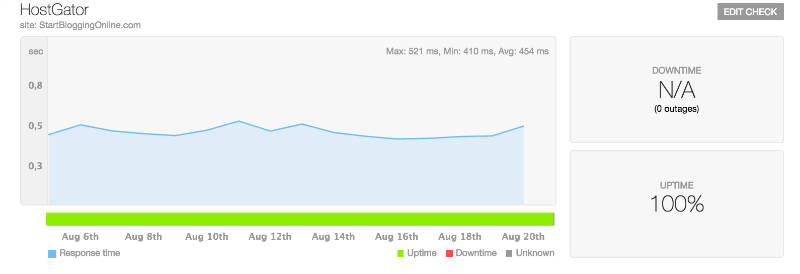
HostGator has great performance, they are easy to use and it’s probably the best pick for beginners.
However, you can always go with another web hosting as long as it’s fast, reliable and offers unlimited storage & bandwidth. This helps you to avoid problems later on.
Now that we’ve gone through the basics of blogging platforms, it’s time to start walking the walk! With the next step, we’ll get your blog set up and running. If you’re not ready yet because you still need to think of a domain name or can’t set up a blog right away, that’s okay. Click here to sign up so that when you’re ready, you can pick up right where you left off.
Step 2: Set up a Blog on your own domain name (self-hosted WordPress)
If you don’t have a hosting or a domain name yet – don’t worry. I’ll be showing this in a minute…
At the end of this step (2), you will have a fully working self-hosted WordPress blog on your own domain name! Sounds promising, huh?
If for some odd reason you don’t want to use HostGator, you can always choose another hosting provider. I can’t promise they’ll be that good, but the registration and the set up process should be some what similar. Some hosting companies do not have one click install for WordPress. If that’s the case, see this guide for installing WordPress manually (not recommended for beginners, though).
1. Go to www.HostGator.com and then click “Start Your WordPress Blog”.
Remember: Since I’m using HostGator by myself too, I’ve negotiated a discount for people who use this guide (72% off). This discount should be applied automatically. Enjoy 

2. Pick a Domain name for your blog
Already have a domain name?Just write it in the right box (I already own this domain) and keep moving to the next step by scrolling down a bit.
How do I choose a good domain name?
Choosing a bad domain name is one of the most common mistakes I see bloggers make. Be sure you choose a domain name that is…
1. Easy to Remember – Don’t choose a nonsense name, something tough to spell, or a long name full of dashes. “www.best-tech-gadgets-in-the-world.com” won’t ever stick in someone’s head, but something like “www.techgeeks.com” rolls off the tongue.
2. Unique and Descriptive – You want a name that reflects who you are and what you care about. Be creative and build an identity you’re excited about!
3. Trustworthy – Domain extensions like “.com”, “.org” or “.net” are the most popular, with “.com” being the one most people think of first. Try to avoid crazy extensions like “.rocks” or “.biz”, as these are less commonly used, tougher to remember and not as trusted.
Type the domain name you want to use in the box, then click “next”. If the name is available, you’ll be able to claim it. If it’s not available, choose another one.
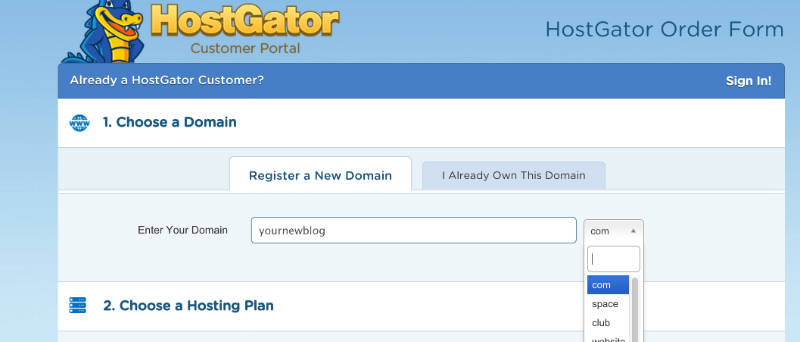
If the name you want isn’t available, HostGator will show you some alternatives that are similar – or you can punch in a new name and try again. I’d suggest you to use something that ends with .com, .net or .org
3. Choose your blog hosting plan
I recommend the “Hatchling” plan for now – you can always upgrade later if you decide you want more advanced features, but you get more than enough with the Hatchling.
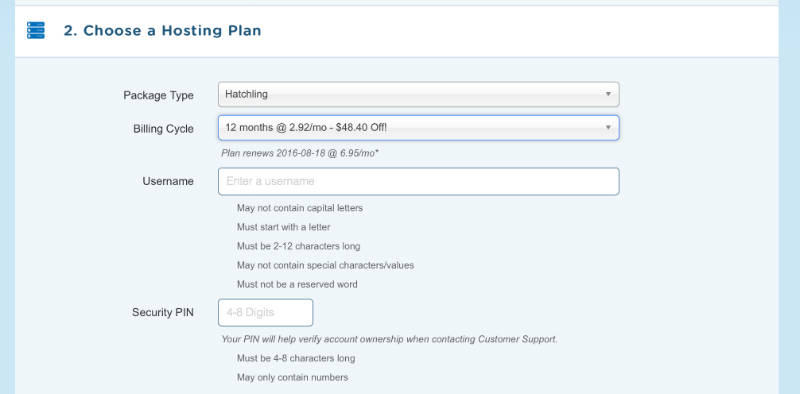
4. Complete your registration
Once you’ve chosen Hatchling plan and found a name you like that’s available, you’ll need to register it by putting in your contact and billing information.
You’ll also have a chance to customize your package a bit. This is a chance to save some more money, so don’t skip it! Apply discount code “STARTBLOG”
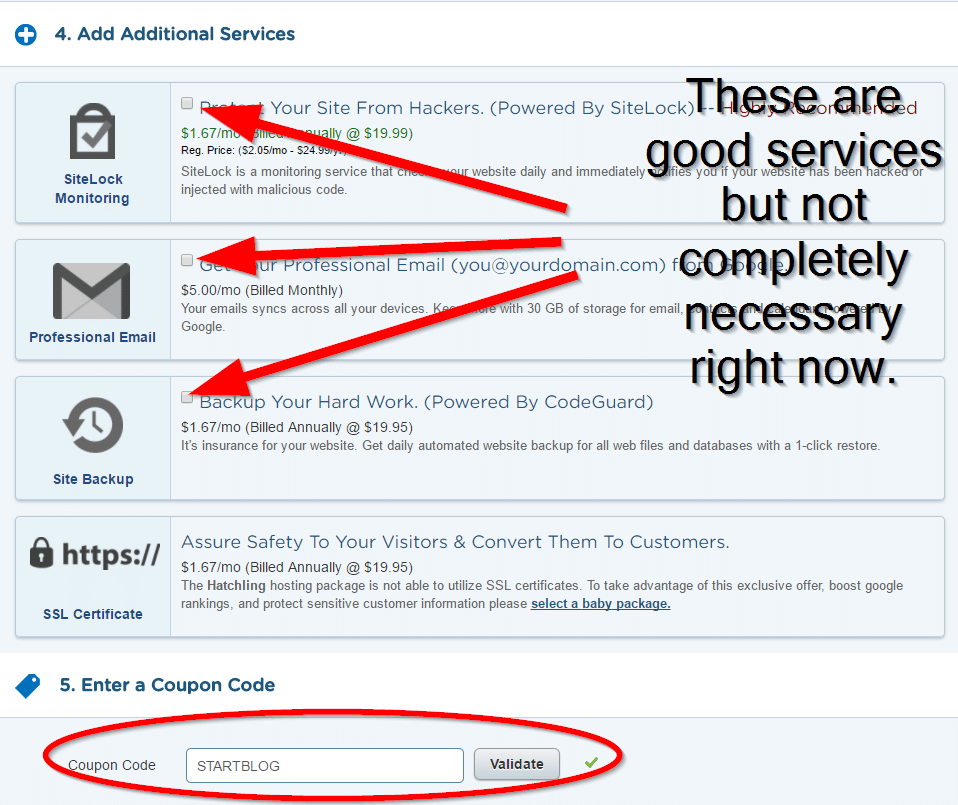
I would take a look at each of these additional services to see if you want any of them. I don’t believe they are necessary for you at this stage.
5. Log in to your new account and install WordPress blog
It may take a few minutes for HostGator to register your account, so be patient. You should get a confirmation email when your account is ready.
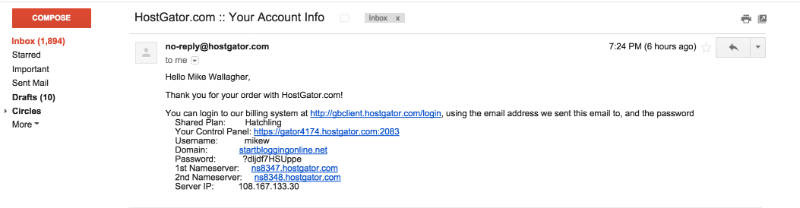
Once you’ve logged in to your control panel (all the information you need for that should be on your inbox) , it’s time to install WordPress. Thankfully, this takes just one click!
- Log-in to your Hostgator control panel
- At the top click “Get Started With WordPress Today”
- If WordPress isn’t there for some reason, scroll down a little bit on the control panel and click on “Quick Install” under the Software & Services section. Look at the top of the page, in the left sidebar section for WordPress.
Once clicked, you’ll be automatically transferred to Mojomarketplace.com – don’t panic, this is just a site that helps HostGator install platforms (like WordPress).
You should immediately see a screen where you’re offered to “Install” or “Import” WordPress.
Click “Install” to get to the next step.
Click “Install” to get to the next step.
When you’re finished, “Install WordPress”. Once you’ve done that, you’ll see a loading bar at the top of your page that will eventually tell you that your WordPress blog has been installed and you’ll see your log-in credentials.
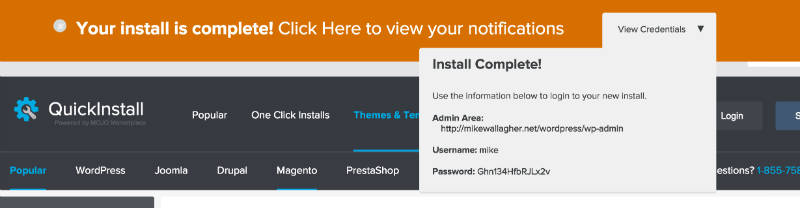
6. Log in in and check out your new blog
Once the installation completes, you’ll get an email that shares your login information, including an “Admin URL”. (In case you missed that notification bar)
To log in to your blog, click the admin URL. If you forget this URL, it’s simply www.yourblog.com/wp-admin (where “yourblog” is your domain name).
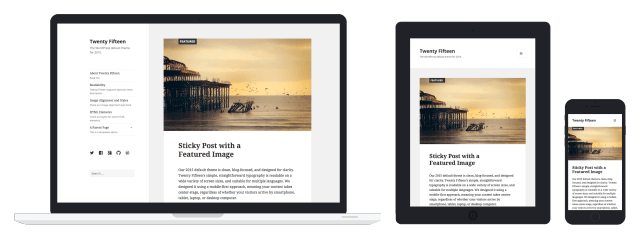
Congratulations – you now know how to make a blog using WordPress. You’ve installed WordPress and set up your blog, all on your own! As you can see, it was really easy and straightforward.
Now that your blog is set up, sign up for my FREE blogging course for tips on how to get readers, earn money, and personalize your blog. Or read on to learn how to design your blog and make your first post.
Step 3: Designing your blog
In this section, I’ll show you some WordPress blog basics, including:
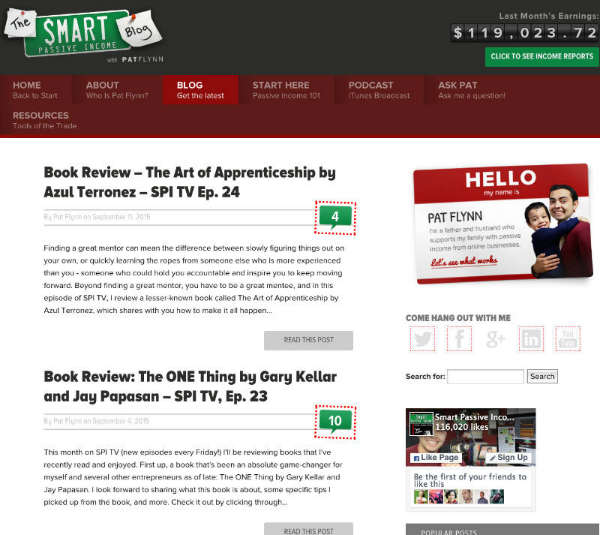
Sample of a customized WordPress blog (SmartPassiveIncome.com)
- Changing your blog’s design
- Installing new plugins/features
- Making your blog search engine friendly
If you’ve set up your blog, you’re now ready to start using WordPress and customizing your blog. I promise – it’ll be pretty easy and fun at the same time.
Remember: You can log in to your blog by going to www.yourblog.com/wp-admin/ and using the credentials you set up with HostGator or any other hosting company you used.
Changing Your Blog’s Design (Themes & Layouts)
WordPress blogging platform uses design templates called “Themes” to figure out how your site should look. Changing your blog’s layout and design is as simple as installing a new theme.
There are over 2,000 professionally designed, fully-c
ustomizable and free themes to choose from – so you’ve got a lot of options. If you want to see premium themes and designs like the Genesis Framework, head over to Themeforest.net
ustomizable and free themes to choose from – so you’ve got a lot of options. If you want to see premium themes and designs like the Genesis Framework, head over to Themeforest.net
Here’s how to find and install a theme you love:
When you log in for the first time, you’ll see a dashboard or admin panel that looks something like this:
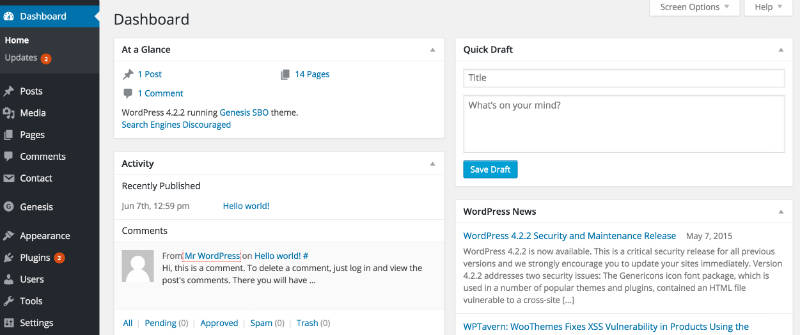
Mouse-over the “Appearance” tab in the WordPress sidebar, then click on “Themes”.
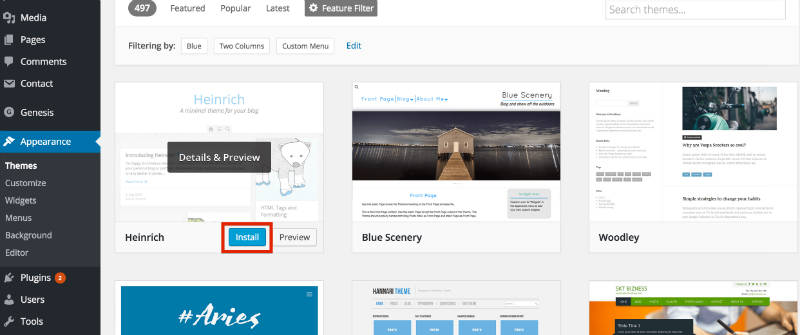
On the next screen, you’ll see several themes are already installed. If you don’t like those, click the “Add New” button at the top, or the great big “Add New” square to start searching for a theme.
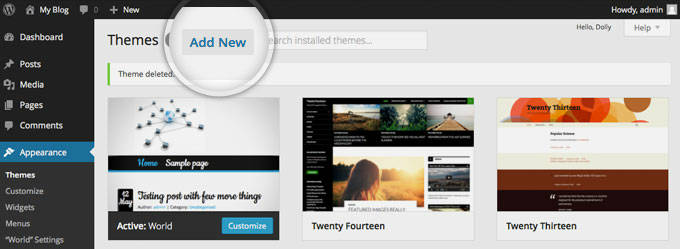
Now, you’ll see tabs where you’ll find featured, popular and brand new themes, as well as a “Feature Filter” and search bar.
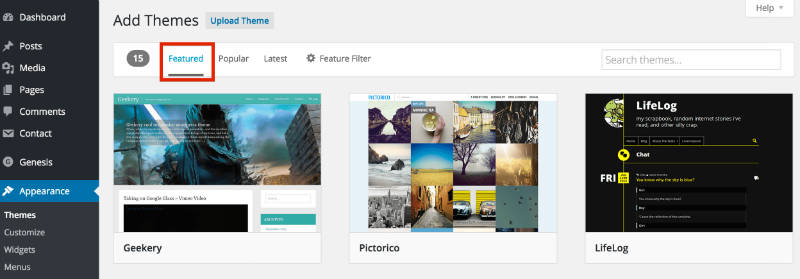
I really like the “Feature Filter” option, because you can choose themes in certain color schemes, select specific layouts and even choose themes with built-in advanced features.
Just choose the options you want, then click “Apply Filters” on the left hand side. If you’re finding this challenging, just search by keyword – there’s no wrong way!
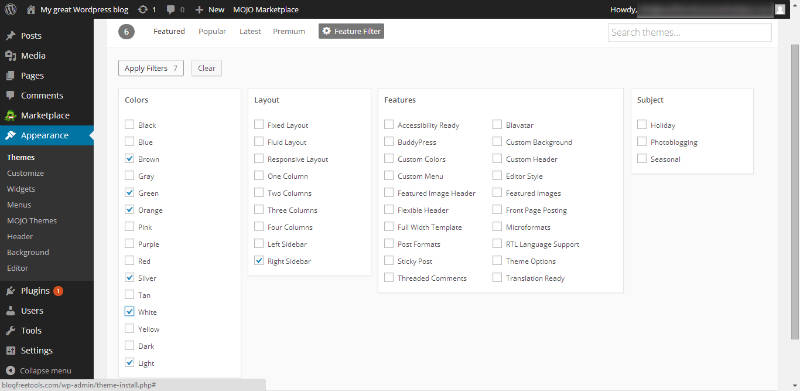
When you’ve found a theme you like, click “Install”. You’re nearly done!
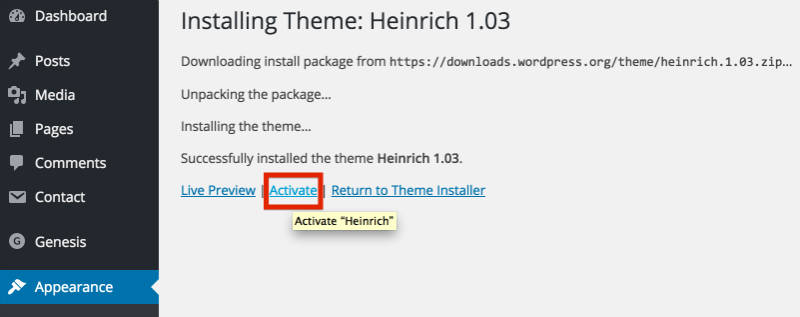
Once the theme has been installed, all that’s left to do is click “Activate” on the next screen:
Configuring your blog to be search engine friendly
There are some things you’d need to do to make your blog more search engine friendly. Search engines do not like two things:
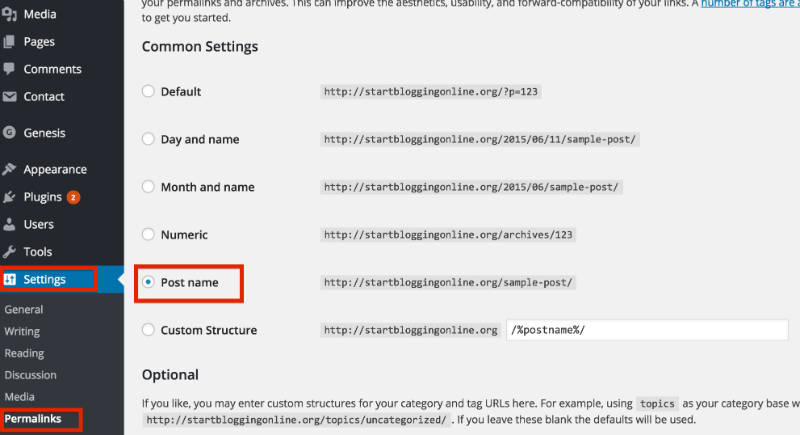
- Ugly and clumsy URL-s – http://yourblog.com/2012/04/topic-a/author-Karen/how-to-start-a-blog. A much better way is to use: http://yourblog.com/start-a-blog
See the difference? One is filled with irrelevant information and the another one is short, clean and neat.
In order to change your links to a more cleaner, click on the “Settings” -> “Permalinks” and use the following settings:
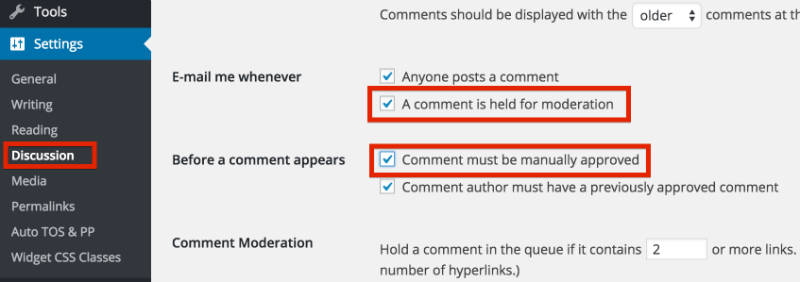
2. Spam comments – Unfortunately, lots of people want to leave automate spam comments on your blog. They do that for couple of reasons – to get people from your blog to their blog and to advertise their services/products.
To avoid that, make sure you moderate your comments. Here’s how to do that: Go to “Settings” -> “Discussion” and tick those two options.
Step 4: Adding/Writing Blog Posts and Pages
By now you should have fully working WordPress blog on your own domain name. You should also have a custom blog theme that fits with your blog’s topic. Congratulations – you’ve done a LOT and I’m proud that you’ve managed to get so far.
In the LAST step, I’ll show you how to write your first blog post and share some tips for writing blog posts.
In this section, I’ll show you…
In this section, I’ll show you…
- How to write a post inside WordPress
- How to add images, links and format text
- Some quick tips and tricks for writing great content
Using WordPress to Blog
Adding a New Post
To add a new blog post, click the “Posts” section on the left hand side-menu, then click on “Add New”.
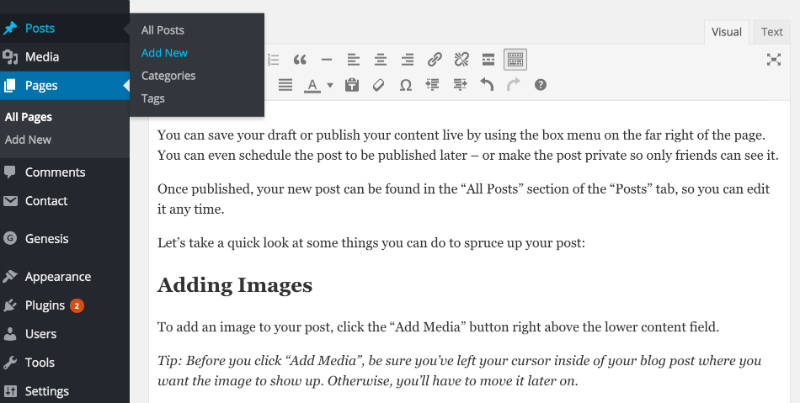
On the next screen, you’ll see something like this:
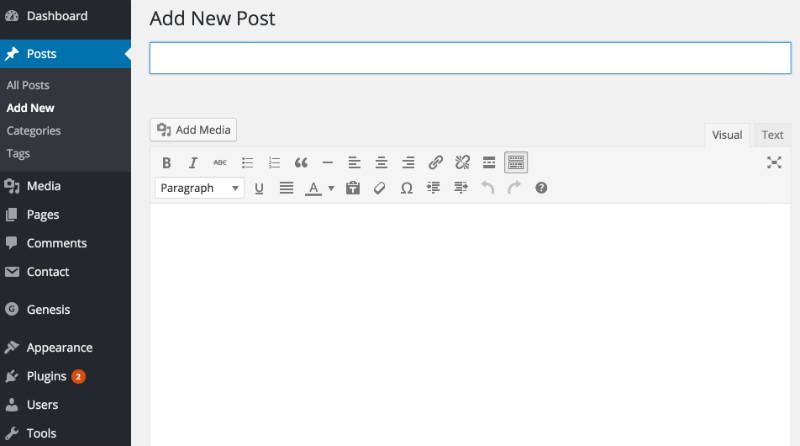
You can add the title to your blog post in the top field, and your content goes in the big text box below the title.
You can save your draft or publish your content live by using the box menu on the far right of the page. You can even schedule the post to be published later – or make the post private so only friends can see it.
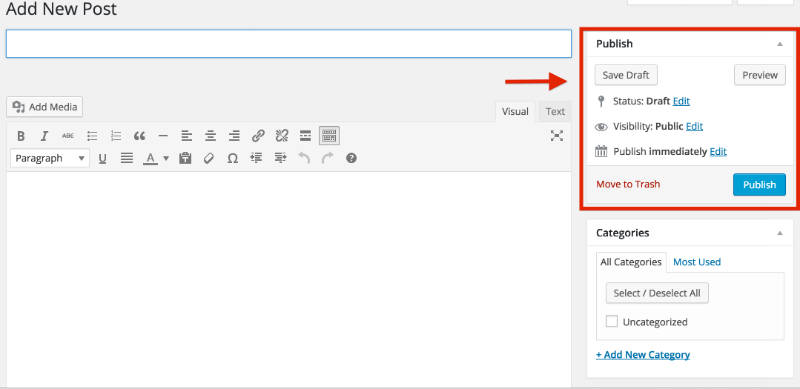
Once published, your new post can be found in the “All Posts” section of the “Posts” tab, so you can edit it any time.
Let’s take a quick look at some things you can do to spruce up your post:
Adding Images
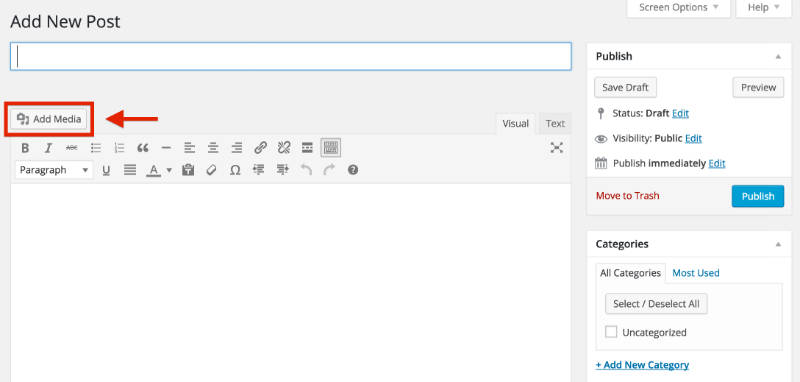
To add an image to your post, click the “Add Media” button right above the lower content field.
Tip: Before you click “Add Media”, be sure you’ve left your cursor inside of your blog post where you want the image to show up. Otherwise, you’ll have to move it later on.
Next, click the “Upload Files” tab on the screen that pops up, then click “Select Files”.
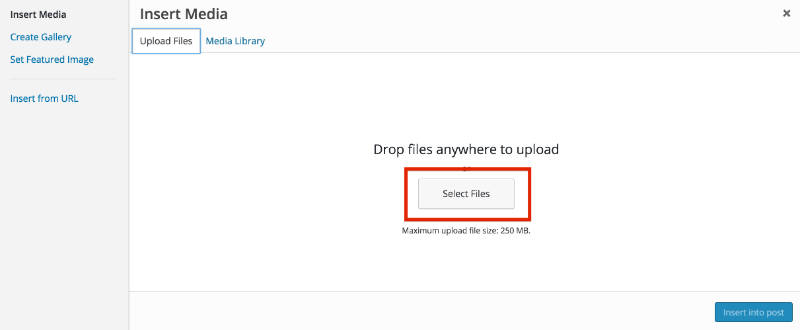
Once you’ve found the file, double click it and WordPress will upload it automatically.
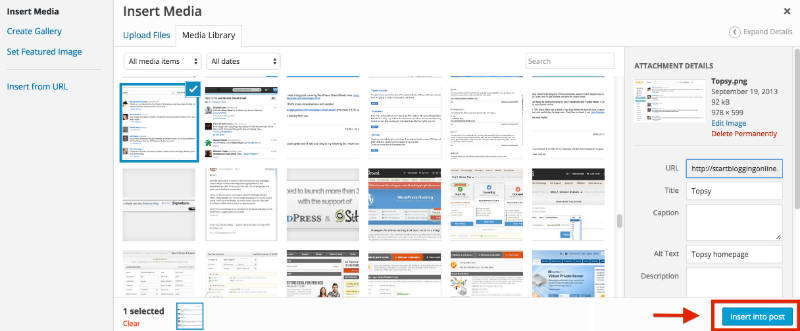
When the upload is finished, make sure the image you want is selected, then click the “Insert into post” button to add the image to the post you’re writing.
Adding a Link
Linking out to other websites is a great way to build relationships and share interesting content.
To add a link, click on the icon in the toolbar that looks a bit like a chain link.

On the pop-up, you’ll need to enter a few important bits of information.
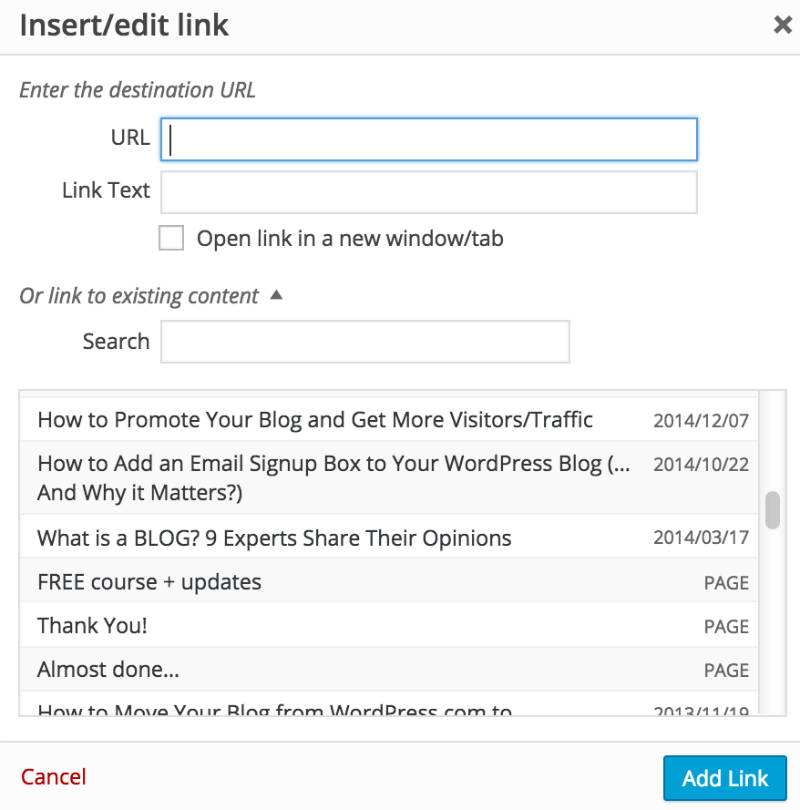
- URL is the web address of the link you want to share. Make sure you include “http://” before the “www.” address, or your link will be broken.
- “Link Text” is the text you want people to click on to get to your link. It might be “Click here”, or anything you choose.
- “Open link in a new window/tab” – it’s a smart idea to check this box. Otherwise, when someone clicks your link, they’ll leave your blog.
- If you want to link to an existing page, you can use the “Search” section to find a post or page you’ve already created and click it to add a link.
Finally, click “Add Link”, and your link will be added where you left your cursor in the post you were writing.
Adding Headers & Editing Text
It’s a good idea to use headers and bolding to make your content easier to read and scan.
Adding Headings
To add a heading, click on the drop-down menu on the bottom left of the toolbar.
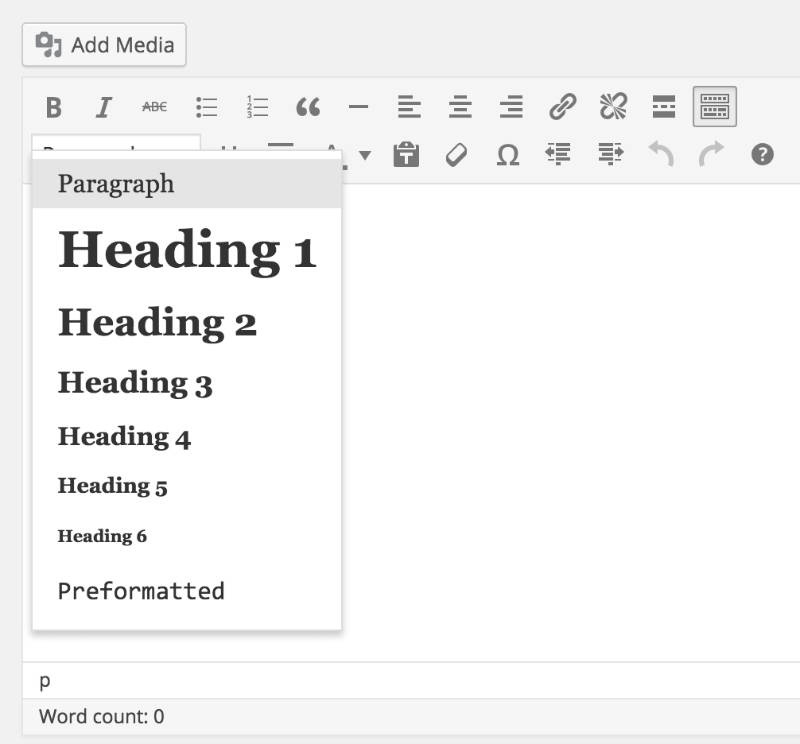
Try to only use “Heading 1” once within your page (usually at the top), and use “Heading 2” or “Heading 3” for other sections in the copy, as this is better for search engines.
Tip: You can also highlight the text you want to change in your blog post, THEN click on the dropdown menu and select the format you want the text to be in.
Editing Fonts
You can also bold, italicize, underline and even change the colour of your text in a click or two.

- “B” is for bolding
- “I” is for italics
- “U” is to underline your text
- “A” will open a dropdown menu where you can select font color
As you can see, this is all pretty simple for someone who has worked with Microsoft Word.
Step 5: Start Growing Your Blog
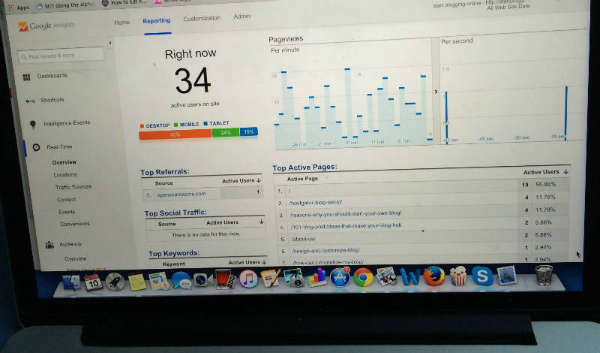
Analytics from StartBloggingOnline.com (taken from my personal laptop).
Now that you have set up your blog and know the basics, it’s time to make your blog successful. Many
beginners struggle at that point, thus I’ve put together a handful of guides to get you going easier.
beginners struggle at that point, thus I’ve put together a handful of guides to get you going easier.
If I were you, I’d suggest you to go and check my resource page here. It contains all the content that I’ve published on StartBloggingOnline.com over the past couple of years. It’s nothing too much, but enough to get you going and a bit more.
Things to do after you’ve created your blog:
The first thing I’d do is create a proper About Me and Contact page.
- Creating a perfect about me page (This is usually the most visited page on your blog)
- Adding a Contact Page/Form on your blog (So that your readers could contact you)
Done those two? Go and read those posts.
- 8 Common blogging mistakes (That many bloggers do, including me)
- Where to find FREE images for your blog (Without braking the copyright)
- 135+ blog post ideas for your NEW blog (Warning: HUGE list)
Ready to take your blog into next level?
Once you have some content on your blog it’s time to get some traffic and make it profitable.
- Get your blog listed on Search Engines (Google, Bing, Yahoo)
- Get more traffic to your blog (I’ve used those techniques personally and they’ve worked well)
- How to monetize your blog (Affiliate marketing, selling advertising space, getting new clients etc…)
- Set up Google Analytics (For tracking your blog visitors)

FAQ (Frequently Asked Questions)
Q: What blog site should I use?
A: WordPress is the most popular platform, powering over 25% of the web! Best of all: it’s free.
A: WordPress is the most popular platform, powering over 25% of the web! Best of all: it’s free.
Q: What should I write about? What blog should I start?
A: Recipe blogs, fitness blogs, and business blogs are some of the most popular.
A: Recipe blogs, fitness blogs, and business blogs are some of the most popular.
Q: How do bloggers make money?
A: There are a number of ways including advertising and digital products, but some people just do it for fun.
A: There are a number of ways including advertising and digital products, but some people just do it for fun.
Q: How Do I Pick A Domain Name?
A: I would suggest using your real name (because you can change it later).
A: I would suggest using your real name (because you can change it later).
Q: Are blogs social media?
A: Blogs can be considered social media, because they have comments and social interactions. However from a technical standpoint, analytics software does not count blog traffic as social media traffic.
A: Blogs can be considered social media, because they have comments and social interactions. However from a technical standpoint, analytics software does not count blog traffic as social media traffic.
Q: Is blogging dead?
A: No way! Over 409 million people read blog posts every month. You’re reading one right now!
A: No way! Over 409 million people read blog posts every month. You’re reading one right now!
Q: What’s the difference between a blog and a website?
A: Blogs are frequently updated with articles while a website is generally “set it and forget it”. Blogs might have less features than a website and just focus on creating really good content. For this reason a blog is more socially active, with shares and comments.
A: Blogs are frequently updated with articles while a website is generally “set it and forget it”. Blogs might have less features than a website and just focus on creating really good content. For this reason a blog is more socially active, with shares and comments.
If you liked this article,please share


 Hello, Anuwa Blessing Cipher. I'm a 18 year old self-employed Blogger,Webdesigner,SEO Expert.
No comments:
Post a Comment